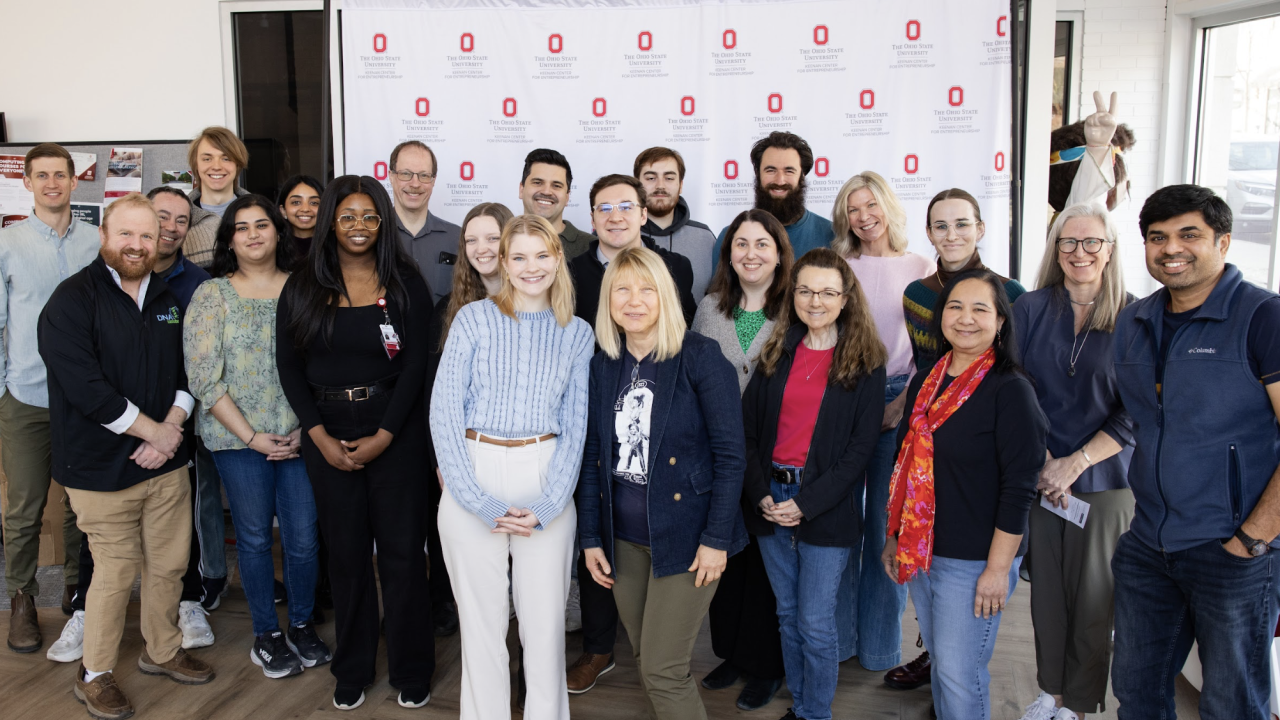
Researchers at The Ohio State University presented new strategies for bringing medical discoveries to market during the National Science Foundation I Corps finale at the Keenan Center for Entrepreneurship, where interdisciplinary teams shared technologies aimed at addressing vision loss, nerve degeneration and next generation drug development.
As part of the new Future Leaders in Innovation and Entrepreneurship program, MBA students teamed up with technology based research teams from the Colleges of Arts and Sciences, Medicine and Engineering to participate in the five week NSF I Corps program.
“The NSF I Corps program challenges researchers to test their ideas outside the lab,” said Caroline Crisafulli, director of entrepreneurial education at the Keenan Center for Entrepreneurship. “By engaging directly with industry stakeholders, teams gain critical insights into whether their technology addresses a significant need. In addition, teaming MBA students with the technology teams provides a collaborative, experiential learning opportunity for STEM and business graduate students.”
The National Science Foundation I Corps program helps researchers explore the commercial potential of their discoveries through an intensive customer discovery process. Over several weeks, teams conduct interviews with clinicians, industry stakeholders and potential users to better understand current pain points and how their technologies might solve problems in existing markets and care systems.
One team, NextGen Oculus, is developing a hydrogel designed to replace the vitreous humor, the clear gel that fills about 80 percent of the eye and helps maintain its shape. The research is led by faculty principal investigator Katelyn Swindle Reilly and PhD student Meghal Keskar with MBA students Connie Skomra and Matheus Fagundes contributing to the project.
As people age, the natural gel inside the eye gradually liquefies, which can place stress on the retina and lead to vision complications. The team’s hydrogel is designed to mimic the properties of the natural gel while remaining optically clear. It can also serve as a platform for delivering medication directly inside the eye through a slow release system.
“If you think of the vitreous humor like gelatin, over decades it begins to liquefy and become stringy,” Keskar said. “That change can place stress on the retina and impact vision. We are developing a substitute that better mimics the native environment of the eye.”
Another team, Oestcore, is exploring a potential treatment for diseases that cause progressive nerve degeneration in the hands and feet. The research is led by faculty principal investigator Kristy Townsend with postdoctoral researcher Gargi Mishra. MBA students Chase Gorman and Bria Isaacson assisted the Oestcore team with customer discovery and market analysis.
These conditions gradually damage peripheral nerves, limiting sensation and motor control and making everyday activities such as walking or buttoning a shirt more difficult. Many current treatments focus on reducing pain rather than stopping the nerve damage itself. The Oestcore team is developing a technology designed to address the biological mechanisms driving the degeneration.
“The technology targets the root cause of the disease rather than simply masking symptoms,” Isaacson said. “It has been exciting to work on something that could be transformative for patients.”
A third team, NucNano, is studying how biological molecules behave at extremely small scales, research that could inform the development of new drugs and biomedical tools. The research is led by faculty principal investigators Michael Poirier, Ralf Bundschuh and Carlos Castro, with doctoral researchers Nils Sommerfeld and Frank Hegedus contributing to the scientific work and MBA student Damiel Faxon evaluating commercialization opportunities.
By examining molecular structures and energy states at the nanoscale, the team aims to better understand how biological systems function and how therapies might be designed with greater precision.
Through the I Corps program, teams interview clinicians, industry professionals and potential users to better understand how their discoveries could translate beyond the laboratory and into real world applications. “It is one thing to analyze a case study,” Faxon said. “It is another to work directly with researchers who are trying to bring a real technology to market.”